Pennsylvania’s state gaming regulator has issued a firm warning to casinos and sportsbook operators over the rapid rise of online prediction markets. Officials say the sector is developing outside the commonwealth’s established legal and tax systems, creating financial, regulatory, and consumer protection concerns for the state’s licensed gambling industry.
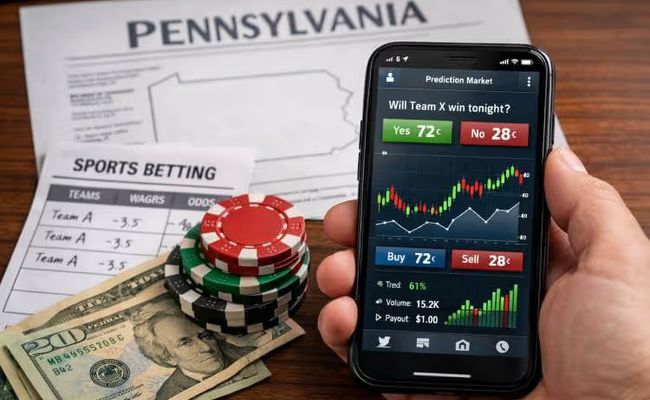
With trades now reaching into the billions of dollars nationwide, regulators and lawmakers are taking a closer look at platforms such as Kalshi, Polymarket, and PredictIt. These apps allow users to buy and sell positions on the likelihood of real-world outcomes, ranging from sports results to political events and entertainment outcomes. Despite that activity resembling gambling to most users, operators insist they fall under federal commodities law, not state gambling law.
The Pennsylvania Gaming Control Board (PGCB) is not convinced, and legislators may soon weigh in.
What Prediction Markets Are and Why Pennsylvania Is Concerned
Prediction markets trade in futures-style contracts tied to real events. Unlike traditional sports betting, contracts change in value as probabilities shift, and users can trade them at any time. The structure appears to involve financial speculation rather than wagering, a distinction that prediction market companies use to justify oversight by federal regulators rather than state gambling departments.
Pennsylvania officials say the distinction is cosmetic and point to widening risks for consumers. During testimony before lawmakers, regulators described an industry growing rapidly without the consumer safeguards required of casinos and sportsbooks. Officials also noted that prediction operators are tapping into fast-moving cryptocurrency markets, further complicating oversight.
The PGCB argues this creates a two-track gambling environment, one highly regulated, one lightly regulated, with both competing for the same customers.
Tax Revenue at Stake as Market Grows
The financial stakes are considerable. Sports betting in Pennsylvania is taxed at 36%, with proceeds allocated to addiction services, public assistance programs, and senior rebate initiatives. Prediction markets currently pay no such state taxes.
State attorneys believe there may already be legal grounds to tax prediction market trades related to sports based on existing language in gaming law. That provision was initially designed to capture untaxed betting activity. Officials now say it may apply equally to prediction platforms that offer sports-related contracts in the state.
Even so, imposing state taxes is likely to trigger a legal challenge from prediction companies, which argue they are neither conducting gambling nor operating inside Pennsylvania’s regulatory jurisdiction.
Rising Problem Gambling Cases Among Young Adults
The issue is not purely financial. Responsible gambling advocates told lawmakers they have seen a surge in contacts from younger Pennsylvanians reporting gambling harm. Data shared during testimony indicated that the highest volume of recent calls to the state helpline came from the 18–24 age group, a demographic historically underrepresented in gambling addiction statistics.
Experts say the new generation of prediction users is drawn in by low minimums, rapid-fire trading, social media marketing, and the perception that financial speculation is less risky than gambling. Advocacy groups also noted that platforms are not required to provide the range of consumer protection tools mandated for state-licensed operators, including spending limits, self-exclusion options, and identity safeguards.
Integrity, Security, and Manipulation Risks
Concerns extend beyond player safety. State officials highlighted rising reports of manipulation and insider trading in prediction markets, particularly in areas where outcomes can be influenced or skewed by information leaks.
Examples discussed included media-linked event markets and warzone mapping disputes that led to unusual payouts. Regulators noted that these cases point to structural integrity weaknesses not present in traditional gambling markets, where outcomes are independently verified and closely monitored.
With monthly trade volume in the billions and significant cryptocurrency activity, the state says the risk of financial misconduct is growing.
Pennsylvania Casinos Advised to Keep Their Distance
The PGCB is urging licensed casinos and partner sportsbooks not to collaborate with prediction platforms, warning that such involvement could jeopardize gaming licenses. Authorities have broad power to determine whether an operator has engaged in unsuitable activity, and offering unregulated prediction products may fall under that definition.
Casinos have also been told to avoid indirectly supporting prediction markets or integrating features that resemble event contract trading. Regulators say maintaining a clean separation is necessary to protect Pennsylvania’s existing gambling framework while the state evaluates its options.
What Comes Next
The debate now moves to the state legislature, which is expected to revisit oversight of prediction markets, taxation, and consumer protection early in the new year. Several court cases are already underway nationwide, and the result may determine whether federal or state law ultimately governs prediction platforms.
For Pennsylvania, the issue is both practical and philosophical. Supporters of regulation say prediction markets blur the line between investing and wagering and risk undermining the safeguards that have shaped the state’s gaming environment. Operators, meanwhile, maintain that their products are part of a modern financial marketplace, not a gambling expansion.
Until those questions are resolved, the PGCB’s message is clear: approach prediction markets cautiously, protect consumers, and be prepared to test new legal and regulatory territory, including taxation.

Reviews (0)
No comments yet. Be the first to comment!